Traditional Jamaican Breakfast
There is a particular hour in a Jamaican household — somewhere between the first crow of the rooster and the moment the sun clears the hills — when the kitchen begins to speak. The hiss of saltfish releasing its brine into a pot of boiling water. The dry rasp of a wooden spoon against an enamel bowl as flour and water become dough. The slow, deliberate chop of onion and scotch bonnet on a wooden board worn smooth by decades of use. For those of us who grew up on the island, these sounds are as familiar as a hymn, and they signal the same thing every time: breakfast is being made, and the day cannot truly begin until it is eaten.
My grandmother, like countless Jamaican women of her generation, treated the morning meal as both a discipline and a devotion. She rose before five — foreday morning (the hour before dawn) — and by the time the household stirred, the air carried the layered perfume of frying dumplings, simmering ackee, and freshly brewed Blue Mountain coffee. To sit at her table was to participate in something older than any of us at it: a culinary tradition forged in the fields and kitchens of post-emancipation Jamaica, refined across generations, and still, remarkably, holding firm against the pressures of modern life.
This article is an attempt to document that tradition with the care it deserves — to explain what constitutes a traditional Jamaican breakfast, why it remains culturally significant, and how those of us in the diaspora might faithfully recreate it in kitchens far from home.
What is the Traditional Jamaican Breakfast
It is worth distinguishing, at the outset, between the everyday Jamaican breakfast and the traditional one, because the two are not the same meal.
Weekday breakfasts in most Jamaican homes have always been brisk affairs: a bowl of porridge — cornmeal, peanut, hominy, or oats, depending on the household and the season — perhaps accompanied by hardo bread with butter or processed cheese, and a cup of Milo, chocolate tea, or coffee. These meals are nourishing and beloved in their own right, but they are not the meal that tourists photograph, that returning Jamaicans request the moment they land at Norman Manley International, or that anchors the cultural identity of breakfast on the island.
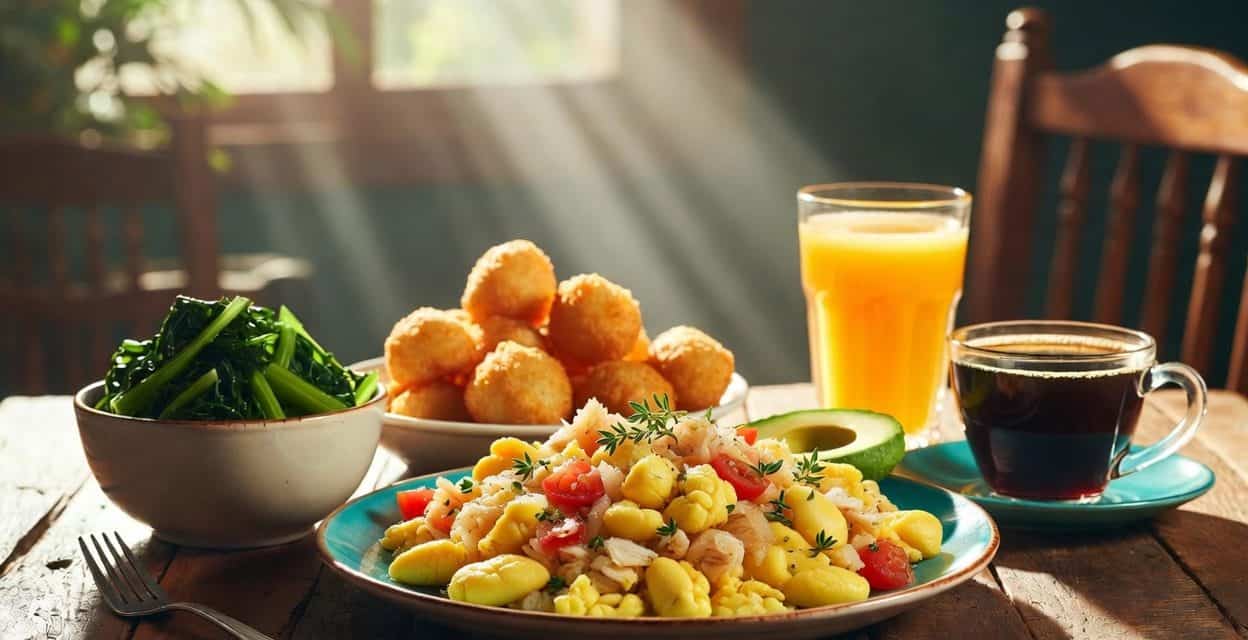
The traditional Jamaican breakfast is, properly speaking, a weekend institution. It is the meal of Saturday and Sunday mornings, prepared without haste and consumed without urgency. Its central components are well established: ackee and saltfish, callaloo, fried dumplings, boiled ground provisions such as green banana and yellow yam, fried ripe plantain, sliced avocado, and a beverage — typically coffee or fresh juice. Variations exist, and we will examine them, but this is the canonical spread.
In recent decades, the picture has grown more complicated. Urban Jamaicans, particularly in Kingston and the major resort corridors, increasingly eat the kinds of breakfasts familiar across the globalized world: granola, smoothies, eggs and bacon, avocado toast. This is neither lamentable nor surprising; cuisines evolve, and Jamaican food has always been an evolving conversation between Africa, Europe, India, China, and the indigenous Taíno. Yet the traditional weekend breakfast has proven remarkably resilient. Even in households where weekdays look thoroughly modern, Saturday and Sunday tend to revert to form. The reasons for this persistence are, I would argue, less about food than about everything food carries with it — and we will return to that point.
Ackee and Saltfish: The National Dish
No discussion of Jamaican breakfast can proceed without first reckoning with ackee and saltfish, the national dish of Jamaica and arguably the most distinctive breakfast preparation in the Caribbean.
Ackee (Blighia sapida) is a fruit native to West Africa, brought to Jamaica in the late eighteenth century — most likely on slave ships, though it takes its scientific name from Captain William Bligh of HMS Bounty fame, who is credited with introducing it to European botanists. The tree thrives in the Jamaican climate, and the fruit became deeply embedded in the local diet. The red, leathery pod ripens on the tree and opens of its own accord, revealing three creamy yellow arils, each crowned with a glossy black seed. Only the aril is edible, and only after the pod has opened naturally. Consumed prematurely or improperly prepared, ackee contains hypoglycin A, a toxin capable of causing what is clinically known as Jamaican Vomiting Sickness, which can be fatal.
This is not a hypothetical concern. It is the reason ackee was, for many years, banned from import into the United States, and the reason diaspora cooks are strongly advised to use commercially tinned ackee — typically from established brands such as Grace or Linstead Market — rather than attempting to source the fresh fruit through informal channels. Properly canned ackee is entirely safe and remains the standard ingredient for diaspora preparation.
Saltfish — salted, dried codfish — entered the Jamaican diet through the colonial trade networks of the eighteenth and nineteenth centuries, when it was imported in vast quantities from the North Atlantic as cheap protein for the enslaved population. That a foodstuff born of brutal economic conditions has been transformed, over two centuries, into the cornerstone of the national dish is itself a quiet testament to the ingenuity of Jamaican cuisine.
Here is how we prepare Ackee and Saltfish at home in Jamaica. The saltfish is soaked overnight in cold water, then boiled briefly to draw out excess salt, drained, cooled, and flaked by hand to remove any remaining bones and skin. In a heavy skillet, coconut oil is heated, and to it are added diced onion, crushed garlic, sliced sweet pepper, sprigs of fresh thyme, and a portion of scotch bonnet pepper — the quantity calibrated to taste, with most cooks erring toward restraint. Once the aromatics have softened, diced tomato is added and allowed to break down. The flaked saltfish follows, absorbing the flavor of the base. Finally — and this step requires a gentle hand — the drained ackee is folded in, never stirred vigorously, as the arils are delicate and prone to disintegration. The dish is covered for two or three minutes to warm through, seasoned with black pepper, and served.
The finished preparation is savory, faintly nutty, with the buttery yellow ackee carrying the salt of the fish and the heat of the pepper in equal measure. It is most often served alongside fried dumplings, boiled green banana, and a wedge of ripe avocado — a combination that, for many Jamaicans, constitutes the platonic ideal of breakfast.
Callaloo
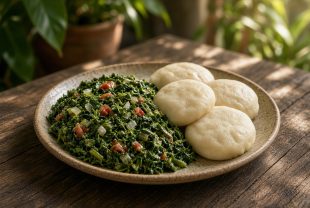
Boiled dumplings with Callaloo
Jamaican callaloo must be carefully distinguished from the Trini dish of the same name, which is a soup incorporating okra and coconut milk. In Jamaica, callaloo refers to the leafy green itself and to how it is prepared. We steam it down with onion, spring onions, garlic, thyme, tomato, and scotch bonnet, often with a touch of butter or oil.
The result is a dark, glossy, deeply savory side dish, mineral and slightly earthy, that occupies the same place on the Jamaican breakfast plate that creamed spinach might occupy on an English one — though the flavor profile is considerably more assertive. Callaloo is also a nutritional workhorse, rich in iron, calcium, and Vitamin A, which is no doubt why grandmothers across the island have, for generations, exhorted their grandchildren to eat it for the sake of their blood.
For diaspora cooks, fresh callaloo can be difficult to source outside of Caribbean and African markets. Tinned callaloo, again from reputable brands, is a reasonable substitute, as is fresh spinach, Swiss chard, or amaranth leaves prepared in the Jamaican manner. The dish derives its character from the seasoning — the thyme, the escallion, the scotch bonnet — more than from the leaf itself, so faithful execution of those elements matters most.
Jamaican Fried Dumplings
If ackee and saltfish is the dish that announces a Jamaican breakfast, then Jamaican fried dumplings are the dish that completes it. Known in some parts of the island as Johnny cakes — a name with disputed etymological origins, possibly derived from “journey cakes” — these golden, hand-shaped breads occupy a permanent place on the breakfast table.
The recipe is among the simplest in the Jamaican repertoire: all-purpose flour, baking powder, salt, occasionally a small quantity of sugar, and enough cold water or milk to form a soft but not sticky dough. The dough is kneaded briefly, allowed to rest under a damp cloth for fifteen to twenty minutes — a step that meaningfully affects the texture, and one that experienced cooks never skip — and then divided, shaped into rounds, and shallow-fried in moderately hot oil until golden brown on both sides.
A well-made Jamaican fried dumpling is crisp on the exterior, with a tender, slightly chewy interior that releases steam when broken open. It serves as both vehicle and counterpoint: sturdy enough to scoop up ackee, mild enough to balance the salt of the fish and the heat of the pepper, satisfying enough to be eaten plain with butter.
Jamaican dumplings exist in other forms as well — boiled dumplings, denser and chewier, typically served in soups or alongside mackerel rundown; and roast or pan-cooked dumplings, made without oil. Each has its place, but at breakfast, the fried dumpling reigns. For a broader survey of the dishes that anchor our cuisine, readers may wish to consult our companion piece on fav Jamaican foods.
The Supporting Elements
A traditional breakfast plate is generous, and several supporting components deserve mention.
Avocado — known in Jamaica simply as pear — appears in thick, creamy slices, providing a cool, fatty counterpoint to the salt and heat of the main dishes. The Jamaican avocado is larger and more buttery than the Hass variety familiar to North American consumers, and its arrival in season is something of a local event.
Fried ripe plantain, cut on the diagonal and shallow-fried until the edges caramelize, contributes a measure of sweetness that balances the savory profile of the plate.
Beverages vary by household. Freshly squeezed orange juice, often from trees in the yard itself, is common. So are juices made from June plum, soursop, carrot (typically blended with condensed milk and grated nutmeg), or, in the Christmas season, sorrel. Jamaican coffee — most prestigiously Blue Mountain, though High Mountain and Mountain Peak are widely consumed — is brewed strong and frequently taken with condensed or evaporated milk. In season, a piece of ripe mango may also appear on the table, and for those unfamiliar with the remarkable variety of mangoes cultivated on the island, we have prepared a detailed guide to the types of Jamaican mangoes.
Regional and Family Variations
While the canonical components of the traditional breakfast are widely shared, considerable variation exists across regions and households.
In rural parishes — St. Mary, St. Ann, Portland, St. Elizabeth — boiled ground provisions tend to occupy a more prominent place on the plate. Green banana, yellow yam, dasheen, and breadfruit, when in season, are non-negotiable accompaniments in many country households. In urban Kingston, by contrast, the meal is often lighter, with fried dumplings or hardo bread taking the place of boiled food.
Coastal communities frequently substitute fresh or salted fish preparations for the canonical ackee and saltfish. Mackerel rundown — salt mackerel simmered in reduced coconut milk until the sauce is thick and burnt-orange in color — is a particular favorite, typically served with boiled dumpling and green banana. Other households favor liver and green banana, steamed fish with hard-dough bread, or fried sprat. In some homes, fried bammy (a flatbread made from grated cassava) replaces fried dumpling entirely.
These variations are not deviations from the tradition; they are the tradition. Jamaican cuisine has never been monolithic, and the breakfast table reflects the geographic, economic, and family circumstances of the household that sets it.
Importance of the Traditional Jamaican Breakfast
To understand why the traditional Jamaican breakfast has endured, one must understand that it is not merely a meal. It is a social institution.
Historically, the substantial Jamaican breakfast emerged from agricultural and maritime labor conditions. Farmers, fishermen, market vendors, and domestic workers faced long days of physically demanding work, often without a substantial midday meal. Breakfast therefore needed to be filling, calorically dense, and slow to digest. The combination of complex carbohydrates (dumplings, ground provisions, plantain), protein (saltfish, ackee, mackerel), and fats (coconut oil, avocado) was not accidental but adaptive.
Equally important is the social function of the meal. In the traditional Jamaican household, breakfast — particularly on weekends — was the principal occasion for family gathering. The midday meal was often eaten at work or school; dinner was sometimes irregular. But breakfast on Saturday and Sunday was reliable. It was the moment at which intergenerational conversation occurred, at which news circulated, at which children listened to the talk of adults and absorbed, without quite realizing it, the values, vocabulary, and history of their community.
For Jamaicans in the diaspora, the traditional breakfast has taken on additional significance as a vehicle of cultural transmission. To prepare ackee and saltfish in a kitchen in London, Toronto, Brooklyn, or Miami is to reach back across distance and time, and to teach a child in those places that they belong to a particular tradition with a particular history.
Cooking While Overseas
For those attempting to recreate the meal outside Jamaica, a few practical considerations are worth noting.
Sourcing ingredients is now substantially easier than it was a generation ago. Caribbean grocery stores in most major diaspora cities stock tinned ackee, tinned callaloo, saltfish, scotch bonnet peppers, fresh thyme, escallion, and frozen breadfruit. Larger Asian supermarkets often carry scotch bonnet or its close relative, the habanero, as an acceptable substitute.
Saltfish preparation is the step most commonly mishandled. Diaspora saltfish can be aggressively salted, and a perfunctory rinse is insufficient. Overnight soaking with at least two changes of water, followed by a brief boil, is the reliable method. The fish should be tasted before incorporation; if it remains too salty, additional soaking is preferable to compensating with other ingredients.
Scotch bonnet handling warrants caution. Gloves are advisable for sensitive skin, the seeds should be removed for milder heat, and small quantities should be used initially. The pepper can be cooked whole and removed before serving to impart flavor without significant heat.
Ackee should be folded, never stirred. Vigorous mixing reduces the arils to a paste, which alters both texture and presentation.
Dumpling dough must rest. The hydration and gluten relaxation that occur during the resting period are essential to the final texture; cooking the dough immediately after mixing produces a dense, leaden result.
For diaspora parents seeking to pass on not only the food but also the language that accompanies it, our ongoing Patwa phrase lessons provide a useful starting point, and kitchen vocabulary is a particularly natural entry into the language.
Frequently Asked Questions
Is ackee safe to consume? Yes, when properly prepared. The pod must open naturally on the tree before harvesting, and unripe ackee should never be consumed. Commercially tinned ackee, which constitutes the majority of ackee consumed outside Jamaica, is processed under regulated conditions and is safe for general consumption.
Can the traditional breakfast be prepared vegetarian? Yes, with relative ease. Ackee prepared without saltfish, using the same aromatics, is an established dish in its own right. Callaloo is naturally vegetarian, as are fried dumplings, plantain, avocado, and the various boiled ground provisions. A complete and satisfying spread can be assembled without animal protein.
What is the difference between fried dumplings and Johnny cakes? The terms are often used interchangeably, though some cooks distinguish Johnny cakes as slightly sweeter or richer, sometimes incorporating milk or additional sugar. The distinction is regional and familial rather than codified.
Can fried dumplings be made in advance? They are best eaten fresh. If necessary, they can be cooled, refrigerated, and reheated in a 350°F oven until warmed through and re-crisped. Microwave reheating is not recommended, as it produces a rubbery texture.
The traditional Jamaican breakfast has survived two centuries of upheaval — emancipation, colonial economic policy, mass migration, globalization, and the relentless acceleration of modern life because it is, in the end, more than food. It is a structured occasion for family, a record of historical adaptation, and a daily reaffirmation that certain things are worth doing slowly and well.
For those of you reading from the diaspora, I would encourage you to attempt the meal in your own kitchen this weekend, with whatever ingredients you can source and whatever family members you can convene. Imperfection is not only acceptable but expected; the tradition has always made room for it.
I welcome your reflections in the comments below. What did breakfast look like in your childhood home, and who presided over the kitchen? Which of these dishes do you continue to prepare, and which have you adapted or set aside? And if this is your first attempt at any of them, do return and tell us how it went.
Walk good.